
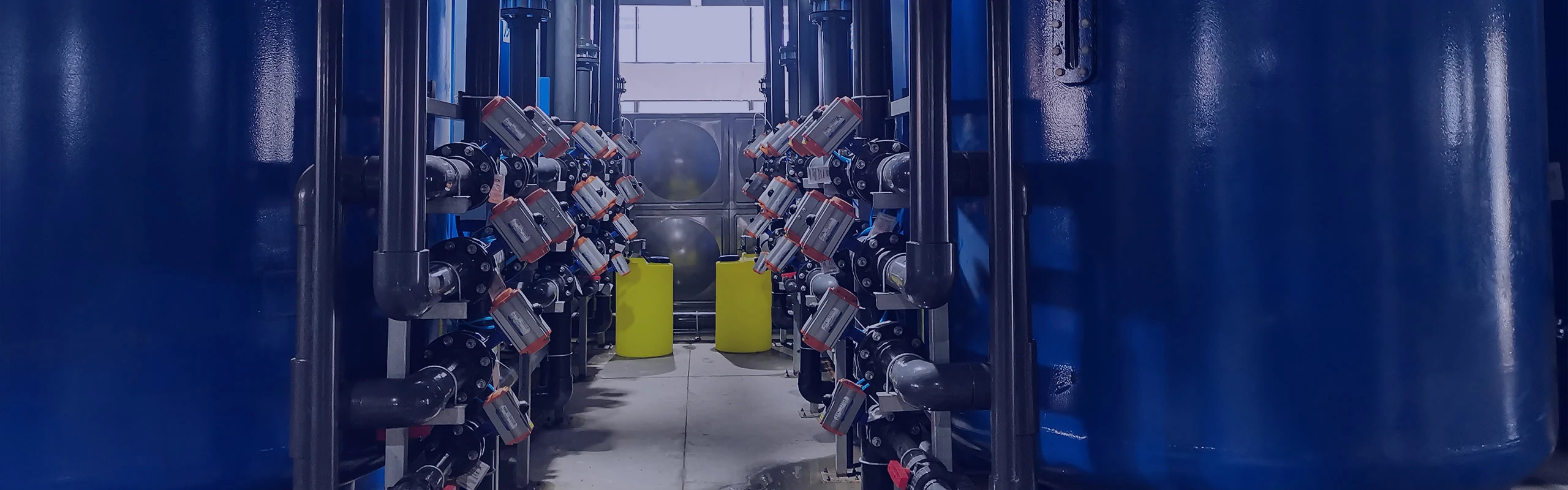
Basic Pretreatment Equipment
Basic Pretreatment Equipment
Product Advantages
Product Details
Structure of Polishing Mixed Bed Equipment
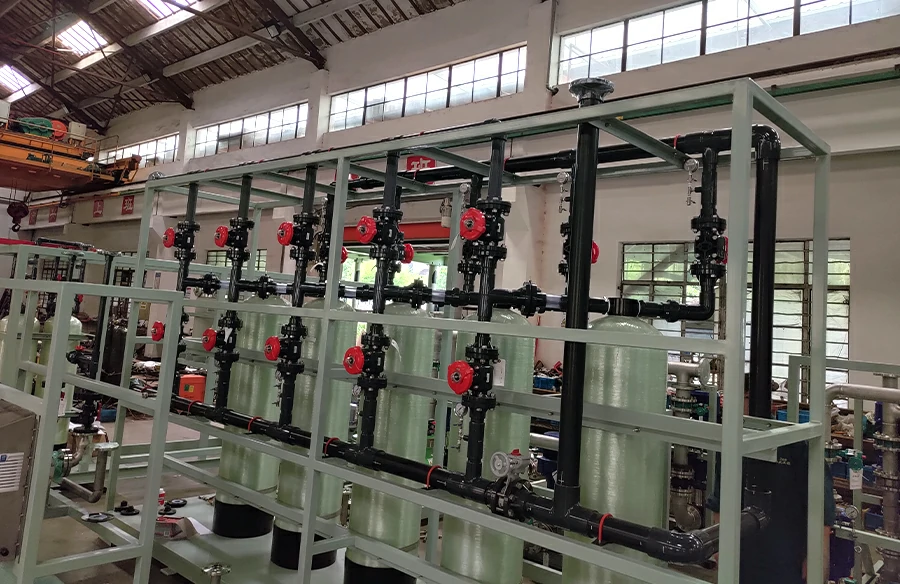
The single-stage polishing mixed bed consists of 2 parallel-operated FRP pressure vessels with a diameter of 510 mm. It is equipped with an ABS water distributor and collector inside. The resin ratio of anion resin to cation resin is 1.5:1, using domestic special resin for ultrapure water. Resin replacement is required when the product water resistivity drops below 12 MΩ·cm (25 ℃). The double-stage polishing mixed bed consists of 2 parallel-operated US-made FRP pressure vessels (model RT1665-45) with a diameter of 510 mm. It is also equipped with an ABS water distributor and collector. The anion-to-cation resin ratio is also 1.5:1, using US-made NM-5DSG (semiconductor-grade mixed bed resin). Resin replacement is required when the water quality fails to meet the required standard.
Main Technical Parameters of Polishing Mixed Bed
| Design Pressure | 0.6Mpa |
| Operating Flow Velocity | Single-stage: 30 m/h, Double-stage: 36 m/h |
| Equipment Capacity | Single-stage: 6 m³/h, Double-stage: 4.5 m³/h |
| Product Water Quality | Single-stage: Conductivity ≤ 0.053 μS/cm (25 ℃), Resistivity ≥ 16 MΩ·cm (25 ℃); Double-stage: Conductivity ≤ 0.053 μS/cm (25 ℃), Resistivity ≥ 18.2 MΩ·cm (25 ℃) |
Principle and Characteristics of Polishing Mixed Bed
1. Principle
This equipment is an ion exchange device in which **anion and cation exchange resins** are filled into the same exchanger in a certain proportion, generally referred to as a **mixed bed ion exchanger (mixed bed for short)**.
In the uniformly mixed resin layer, the cation and anion resins are closely interlaced.Each pair of cation and anion resin particles is similar to a dual bed unit.Therefore, the mixed bed can be regarded as an ion exchange equipment operated in series with countless dual bed units.
2. Characteristics
Following mixed ion exchange, hydrogen ions and hydroxide ions in the water immediately form water molecules (H₂O) with very low ionization. The formation of counter ions during cation or anion exchange is largely eliminated, enabling the exchange reaction to proceed extremely thoroughly and producing high-quality purified water. Generally, in mixed beds filled with strong acid and strong base resins, the effluent salt content is below 1 ppm, conductivity is less than 0.1–0.2 μS/cm, silica leakage is approximately 20 ppb, and the effluent pH is neutral.
It features high and stable product water quality. Short-term changes in operating conditions (such as inlet water quality, composition or flow rate) have little impact on the effluent quality of the mixed bed.
Intermittent operation has little effect on product water quality, and it takes a short time to restore the water quality to the level before shutdown. The exchange endpoint is obvious.
Installation, Maintenance and Operation of Polishing Mixed Bed Equipment
The equipment shall be installed in accordance with the requirements shown on the supplied general layout drawing.
The polishing mixed bed is made of FRP material, so severe collision to the equipment body shall be strictly prohibited.
Its operating temperature shall not exceed 40 ℃. Any baking by other heat sources around the equipment is strictly prohibited, and welding with open flame near the equipment is not allowed. If the equipment is not used immediately upon arrival at the site, it shall be moved indoors for storage, with the general indoor temperature maintained between 5 ℃ and 30 ℃. Outdoor storage is strictly forbidden.
Defective water caps must not be used under any circumstances. The water caps are made of ABS material.
Replace the resin in a timely manner according to the water quality requirements.
When replacing the resin and putting it into operation again, flushing and draining shall be carried out for a period to ensure the new resin is cleaned as thoroughly as possible.