Product Advantages
Product Details
Various impurities in water can affect the operation and product water quality of two-stage reverse osmosis pure water equipment. Suspended and colloidal impurities, such as sediment, clay, algae, etc., with particle sizes ranging from 1 nm to 100 μm, tend to block the microporous structure of RO membranes, increase operating pressure, reduce water production efficiency, and form a cake layer after long-term accumulation, impairing the salt rejection performance of the membrane. Dissolved salts, including various cations (such as Ca²⁺, Mg²⁺, Na⁺, etc.) and anions (such as Cl⁻, SO₄²⁻, HCO₃⁻, etc.), will cause concentration polarization on the RO membrane surface at high concentrations, resulting in increased salt passage, decreased salt rejection, and even scaling which damages membrane elements. Organic substances such as humic acid, fulvic acid, surfactants, etc., adsorb onto the membrane surface to form an organic fouling layer, hindering water permeation. They may also chemically react with membrane materials, shortening the service life of the membrane. Microorganisms, including bacteria, fungi, algae, etc., multiply on the membrane surface under suitable conditions to form a biofilm. This not only blocks membrane pores but also releases metabolites that contaminate product water quality, posing a serious threat to the long-term stable operation of the equipment.
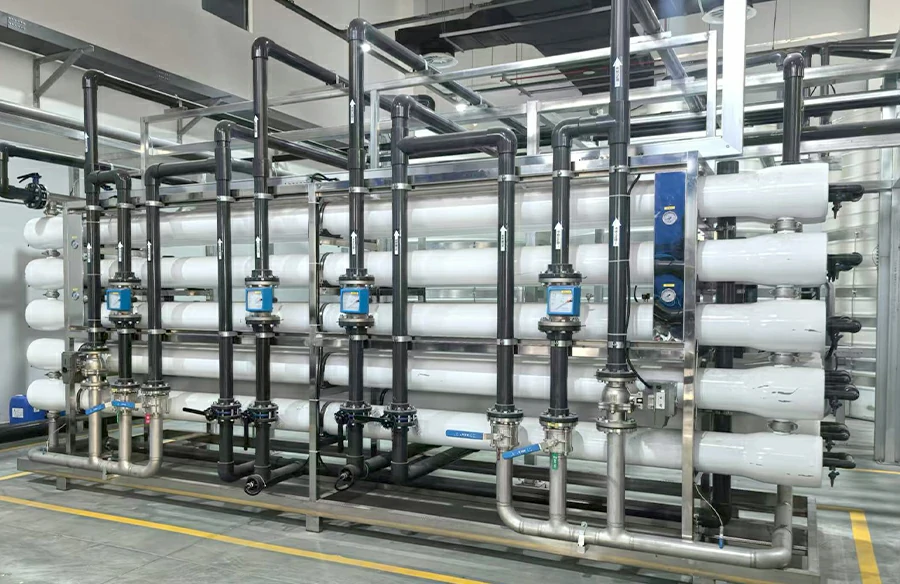
The equipment mainly consists of the following key components. Pretreatment System, including multi-media filter, activated carbon filter, security filter, etc. Its function is to remove large suspended solids, colloids, organic matter, residual chlorine and other impurities in water, reduce turbidity and fouling index, provide good feed water conditions for subsequent reverse osmosis treatment, and protect RO membrane elements from pollution and damage. RO Membrane Assembly is the core treatment unit of the equipment, composed of two-stage RO membrane elements. The first-stage RO membrane removes most salts and impurities, while the second-stage RO membrane further polishes the water to ensure high-purity product water quality. The RO membranes are international famous brands such as Dow and Hydranautics (USA), featuring high flux, high salt rejection and long service life. High-pressure Pump provides sufficient feed pressure for the RO membrane assembly to overcome osmotic pressure and flow resistance, allowing water molecules to pass through the RO membrane smoothly and realize the separation of water and impurities. Control System consists of PLC controller, touch screen, sensors, etc. It monitors operating parameters in real time, such as pressure, flow, conductivity, pH value, etc., and automatically adjusts the operating status according to the set program, realizing intelligent control and management of the equipment. Cleaning System includes cleaning tank, cleaning pump, security filter, etc. When fouling occurs on the RO membrane surface, the cleaning system performs chemical cleaning to remove contaminants, restore membrane performance and extend its service life.
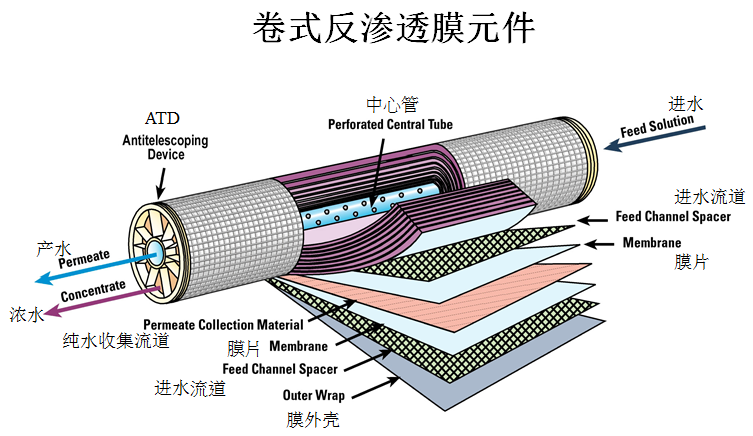
Reverse Osmosis (RO) is a process in which pressure is applied to force the solvent in a solution to pass through a reverse osmosis membrane for separation. As it runs opposite to the direction of natural osmosis, it is called reverse osmosis. Based on the different osmotic pressures of various substances, reverse osmosis with pressure higher than the osmotic pressure can achieve the purposes of separation, extraction, purification and concentration. The separation and concentration of solutes and water can be carried out at room temperature, resulting in low energy consumption and a wide range of impurity removal. It can remove inorganic salts and various organic impurities, with a high water recovery rate.
Conductivity of first-stage RO permeate ≤ 10 μS/cm, conductivity of second-stage RO permeate ≤ 3 μS/cm.